Supramolecular Predisposition Promotes Intramolecular Heavy-Atom Effects for Self-Sensitized Oxidation
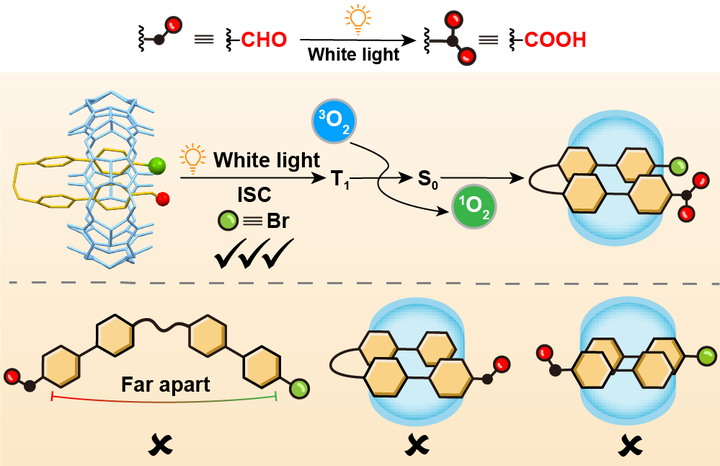 Image credit: the authors
Abstract
Supramolecular confinement is widely used to control molecular architecture, but its use to direct excited-state reaction pathways remains underexplored. This limitation is particularly evident for spin-forbidden processes such as intersystem crossing (ISC), which are difficult to regulate through supramolecular design. The heavy-atom effect, although central to promoting ISC, is typically regarded as an intrinsic substituent property rather than a geometry-dependent supramolecular parameter. Here we show that macrocycle-directed supramolecular predisposition can deliberately enforce intramolecular heavy-atom effects to activate latent spin-forbidden transitions, enabling efficient self-sensitized oxidation. Encapsulation of a flexible aldehyde- and bromine-substituted guest within cucurbit[8]uril (CB[8]) enforces a folded geometry that juxtaposes the heavy atom and reactive aldehyde, as established by solution studies and single-crystal analysis. Under white-light irradiation, this predisposed complex undergoes selective oxidation of the aldehyde to the corresponding carboxylic acid. Control experiments varying heavy-atom identity, cavity size, and guest binding modes define CB[8]-enforced spatial juxtaposition as the critical structural requirement, while scavenger and EPR studies support triplet-oxygen energy transfer to generate singlet oxygen as the operative pathway. Preferential binding of CB[8] to the substrate over the product mitigates product inhibition and allows catalytic turnover under substoichiometric host loadings. These results show that macrocyclic encapsulation does more than statically stabilize a host−guest complex: it transforms spatial geometry into a structurally gated switch for spin-forbidden pathways, establishing supramolecular predisposition as a versatile design principle for developing switchable photocatalysts and conformationally responsive smart materials.
Fei Li
PhD Candidate (2023)
Be enthusiastic, proactive, optimistic, and inquisitive. Above all, eat well and live seriously.
Yibin Sun
Assistant Professor
Research interests: catassembly, assembly kinetics, protein-protein assembly, and protein engineering
Guanglu Wu
Professor
Research interests: multi-component functional assemblies, noncovalent dimerization, supramolecular catalysis, and smart soft matter