In the span of just two weeks in late May and early June 2025, the supramolecular chemistry community gathered twice in Asia: first at ISMSC 2025 in Kyoto, and then at JCCC 2025 in Macao. Both meetings revolved around macrocyclic chemistry and submissions for this special issue (and the one for ISMSC2025) inevitably resonated with the themes of both conferences. Rather than overlap, we see this as a reflection of a burgeoning field in rapid motion, where ideas travel quickly, and communities remain tightly connected.
Attending both events offered a fascinating contrast in conference dynamics. ISMSC 2025 offered a panoramic view of supramolecular chemistry at its broadest. With all the talks delivered to nearly a thousand participants in a single large venue, one could experience – without the need to choose – the astonishing diversity and creativity of the field. It was an inspiring reminder of how many directions supramolecular chemistry has taken, and how much fertile ground is still yet to be explored.
JCCC 2025, however, felt fundamentally different. Bringing together over 300 researchers from more than 20 countries, the conference adopted a deliberately intimate format, with multiple parallel sessions and small room sizes. This structure created a space where discussions were relaxed, candid, and often delightfully intense. Being surrounded by close peers working on related macrocyclic systems, as early-career chemists, we felt not only inspired but truly involved. There was a strong sense of shared understanding of the challenges our field faces, and an equally strong willingness to question assumptions and push boundaries together.
Across JCCC 2025, we witnessed the macrocyclic community actively redefining its frontiers: including the design of entirely new macrocycles, the pursuit of ultra-high binding affinities, deliberate control over slow dissociation kinetics, the deepening of cavities towards extended architectures, and increasingly sophisticated approaches that have helped clarify the intimate relationship between cavity desolvation and binding affinity. Equally exciting were the emerging perspectives shifting attention from the inner to external spaces of macrocycles, recognising supramolecular intermediates as meaningful conceptual entities, developing new methods to probe molecular flexibility, and re-emphasising that even fundamental measurements such as binding affinity demand rigour and ‘good behavior’ on the part of the host. These examples represent only a glimpse of the rich scientific landscape discussed at the meeting. When closely related work is discussed side by side, genuinely original ideas stand out with remarkable clarity, revealing new growth points for the field.
We are profoundly grateful to the Conference Chair, Professor Ruibing Wang, whose long-standing commitment to the cucurbituril and macrocyclic community made JCCC 2025 possible. His dedication, memorably captured years ago by Professor Werner Nau as ‘one day cucurbituril, forever cucurbituril,’ enabled us to finally gather in Macao despite repeated delays and unexpected challenges brought by the pandemic. We are also delighted by the strong emphasis placed on nurturing the next generation, exemplified by the presentation of Best Poster Awards and Outstanding International Student Scholarships to brilliant young researchers.
The next JCCC is planned to take place in the United Kingdom, and we already look forward to meeting old friends again, welcoming new faces, and sharing new ideas that will continue to shape the field. See you all in 2027!
But before that. It has been our distinct honour and pleasure to guest edit this Special Issue of Supramolecular Chemistry dedicated to JCCC 2025. For us, this has been an opportunity to grown as individuals; in ways that emphasise the importance of community. The included articles offer but a small taste of the meeting last summer. But, we hope you enjoy them as much as we did working with the editors and collating the articles.
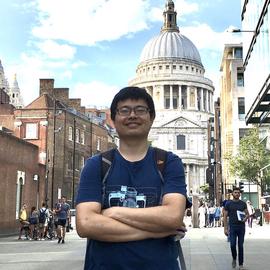
Guanglu Wu
Professor
Research interests: multi-component functional assemblies, noncovalent dimerization, supramolecular catalysis, and smart soft matter