Ultra-High Metal-Ion Selectivity Induced by Intramolecular Cation-π Interactions for the One-Pot Synthesis of Precise Heterometallic Architectures
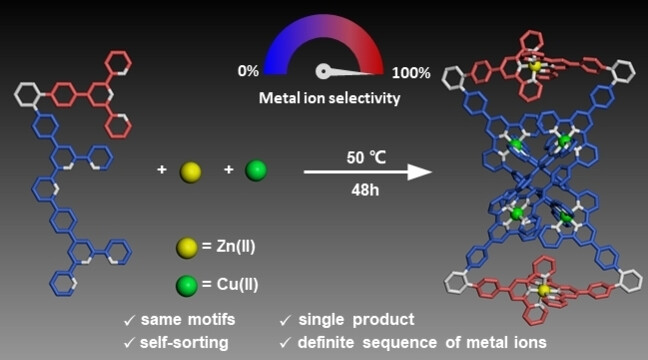 Image credit: Wiley
Abstract
Heterometallic supramolecules, known for their unique synergistic effects, have shown broad applications in photochemistry, host-guest chemistry, and catalysis. However, there are great challenges to precisely construct heterometallic supramolecules rather than a statistical mixture, due to the limited metal-ion selectivity of coordination units. In particular, heterometallic architectures precisely encoded with different metal ions usually fail to form in a one-pot method when only one type of coordinated motif exists due to its poor metal-ion selectivity. Herein, we propose an effective intramolecular cation-π (ICπ) strategy and successfully constructed the heterometallic supramolecule Zn2Cu4L34 by the one-pot self-assembly of tritopic terpyridyl ligand L3 with Zn(II) and Cu(II), following a clear self-assembly mechanism in which only thermodynamic dimers ZnL12 and Cu2L22 were constructed with model ligands L1, L2, Zn(II) and Cu(II) with perfect self-sorting and an ultra-high metal-selectivity feature. The successful construction of the heterometallic supramolecule Zn2Cu4L34, in which the definite sequence of metal ions Zn(II) and Cu(II) is encoded in the one-pot method, will offer a novel approach to precisely construct heterometallic architectures.

Tianyi Yang
PhD graduate (2021)
Happiness lies in contentment. Casual most of the time, deeply focused when something catches her.

Guanglu Wu
Professor
Research interests: multi-component functional assemblies, noncovalent dimerization, supramolecular catalysis, and smart soft matter