γ‐Cyclodextrin‐Based 2:2 Host–Guest Complexes With Emergent Circularly Polarized Luminescence
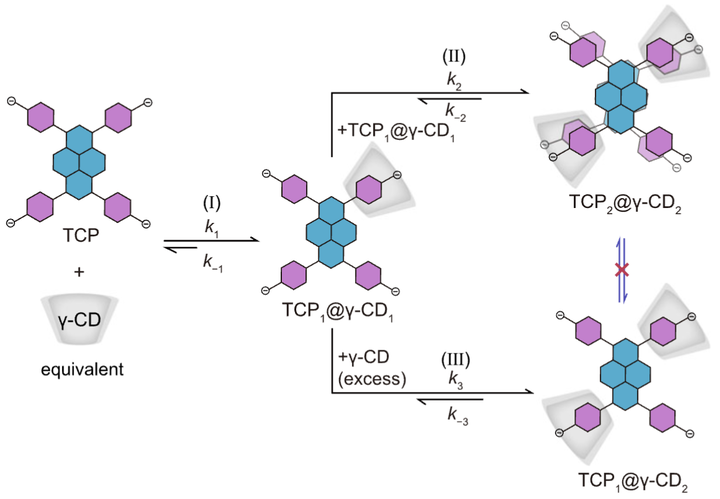 Image credit: Source
Abstract
Discrete 2:2 host–guest complexes provide a well‐defined platform for correlating supramolecular structure with emergent photophysical behavior. Although γ‐cyclodextrin (γ‐CD) is widely used in aqueous host–guest chemistry, structurally well‐defined 2:2 complexes and their formation mechanisms remain poorly understood. Here we report a γ‐CD‐mediated 2:2 host–guest complex formed with 1,3,6,8‐tetrakis(4‐carboxyphenyl)pyrene tetrasodium salt (TCP) and systematically elucidate its structural, mechanistic, and photophysical characteristics. Combined 1 H NMR, 2D NMR, and DOSY analyses resolve the 2:2 architecture, while thermodynamic and kinetic studies reveal a multistep complexation network involving 1:1, 1:2, and 2:2 species, with dimerization providing the dominant thermodynamic driving force. The resulting 2:2 complex exhibits enhanced fluorescence emission and pronounced chiroptical responses, including circular dichroism and circularly polarized luminescence, arising from supramolecular chirality induced by the chiral γ‐CD cavities. Importantly, analogous γ‐CD‐mediated 2:2 complexation and associated photophysical features are also observed for a tetraphenylethylene‐based guest, indicating that this binding mode is not limited to a single chromophoric scaffold. This study clarifies how 2:2 host–guest complexes can form in γ‐CD systems and provides mechanistic insight into the emergence of chiral photophysical properties in such complexes.



Guanglu Wu
Professor
Research interests: multi-component functional assemblies, noncovalent dimerization, supramolecular catalysis, and smart soft matter

Yibin Sun
Assistant Professor
Research interests: catassembly, assembly kinetics, protein-protein assembly, and protein engineering