 Image credit: Source
Abstract
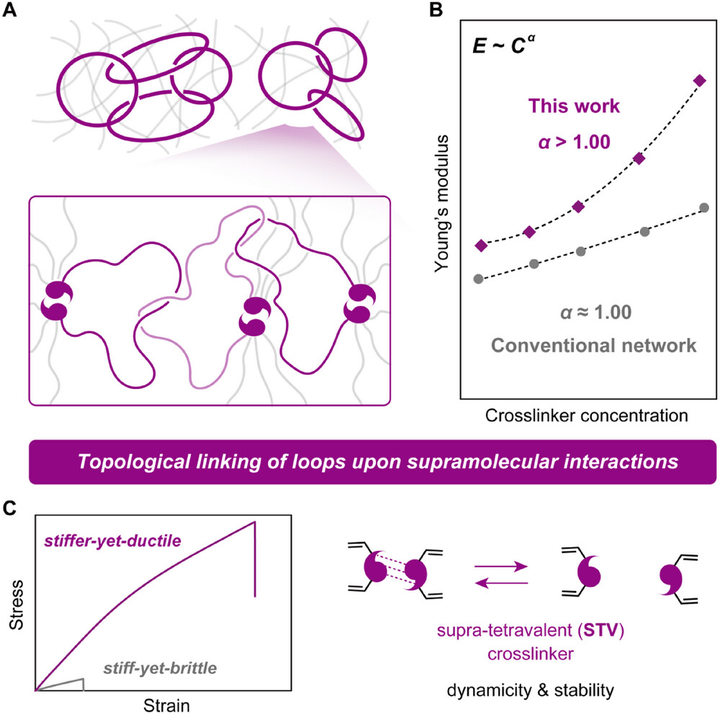
Polymer networks possess numerous elastically defective and isolated loops, which do not contribute to mechanical stiffness. In this report, we introduce a strategy of supramolecular topological linking to access stiffer‐yet‐ductile polymeric materials through incorporation of supramolecular tetravalent crosslinkers. Dynamic dissociation/re‐association between these high‐functionality crosslinks enables the formation of topologically‐linked loops that serve as elastic springs to stiffen the networks. An exceptional scaling exponent of 2.05 for Young’s modulus versus crosslinker concentration is obtained, exceeding most reported randomly‐crosslinked polymeric systems. Compared to conventional analogs, the mechanical properties of the resultant materials are enhanced: Young’s modulus (2‐fold), elongation at break (8‐fold), and work of fracture (100‐fold). Uplifting modulus scalings through supramolecular topological linking paves a new path to the design of stiffness‐reinforced soft materials, holding substantial promise in load‐bearing application scenarios such as tissue implants, bioelectronic interfaces, and soft robotics.

Guanglu Wu
Professor
Research interests: multi-component functional assemblies, noncovalent dimerization, supramolecular catalysis, and smart soft matter