Quaternary 2:2 Complexes as Kinetic Intermediates: Unveiling an Overlooked Pathway in Cucurbit[8]uril-Mediated Assembly
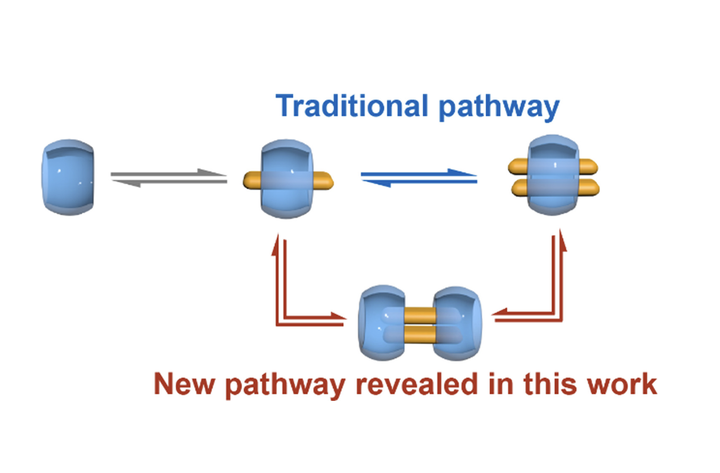 Image credit: CCS
Abstract
Molecular assembly is typically viewed as a stepwise process from lower- to higher-order structures. Here, we uncovered an alternative kinetic pathway in the cucurbit[8]uril (CB[8])-mediated assembly, where a transient quaternary (2:2) complex formed before the thermodynamically favored ternary (2:1) product. Stopped-flow spectroscopy and structural analysis confirmed the 2:2 intermediate, which formed 36-fold faster than the direct 1:1 → 2:1 pathway at 298 K. The system thus accumulated in the 2:2 state before relaxing to the 2:1 product. These findings revise the conventional binary-to-ternary model and highlight the mechanistic relevance of higher-order intermediates. It also refines our understanding of apparent cooperativity within a complex assembly network. Recognizing such kinetic complexity opens new avenues for dynamic control in the design of high-performance functional and structural materials.

Tianyi Yang
PhD graduate (2021)
Happiness lies in contentment. Casual most of the time, deeply focused when something catches her.

Yuanchen Shen
Bachelor’s graduate (2019)
Sought to understand how research works through early lab practice.

Haoyuan Qu
PhD Candidate (2022)
This student is a genuine Changchun native, friendly and approachable.

Yibin Sun
Assistant Professor
Research interests: catassembly, assembly kinetics, protein-protein assembly, and protein engineering

Guanglu Wu
Professor
Research interests: multi-component functional assemblies, noncovalent dimerization, supramolecular catalysis, and smart soft matter