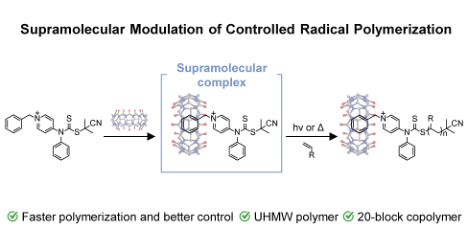
 Image credit: the authors
Abstract
Controlled radical polymerization has fundamentally transformed polymer science, enabling the synthesis of materials with precisely tailored architectures and predictable molecular weights. However, achieving rapid polymerization while maintaining good control remains a great challenge in controlled radical polymerization. Herein, we report a supramolecular strategy to alleviate this problem in aqueous photoiniferter and reversible addition–fragmentation chain transfer (RAFT) polymerizations through host–guest complexation between cationic thiocarbonylthio-based agents and cucurbit[7]uril (CB[7]). Such encapsulation induces a significant increase in the chain transfer coefficient and photolysis efficiency of the CTA. Spectroscopic and computational analyses reveal that the macrocyclic host promotes triplet-state population via enhanced spin–orbit coupling, while simultaneously lowering fragmentation barriers and facilitating reversible deactivation. This mechanistic synergy enables the synthesis of ultrahigh-molecular-weight polymers (M_n up to 2,190 kg mol−1) and the rapid construction of well-defined 20-block copolymers with excellent end-group fidelity and high initiator efficiency. This supramolecular strategy yields accelerated yet highly controlled polymerizations in aqueous media, providing a promising approach to balancing rate and control using dithiocarbamate-based chain transfer agents.

Guanglu Wu
Professor
Research interests: multi-component functional assemblies, noncovalent dimerization, supramolecular catalysis, and smart soft matter