Portal-directed assembly of 2D cucurbituril-polyoxometalate hybrids toward synergistic photothermal catalysis
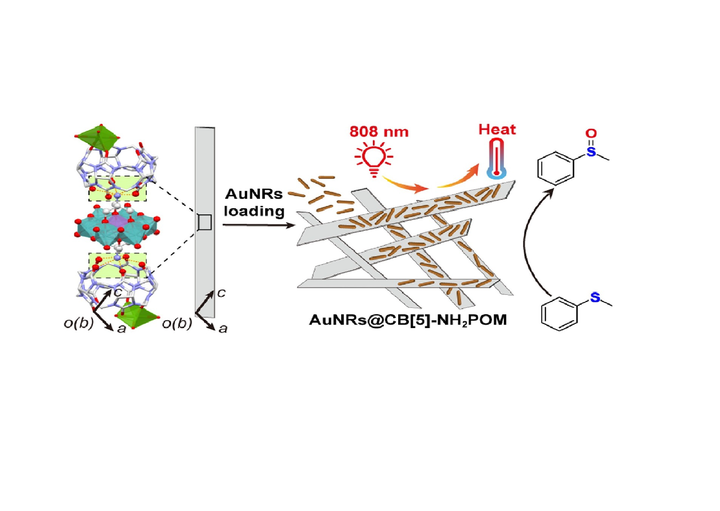 Image credit: ACS
摘要
Precise control over the dimensionality and morphology of supramolecular assemblies remains a key challenge in hybrid material design. Here we report a directional assembly strategy that exploits synergistic portal-specific hydrogen bonding and ion-dipole interactions between cucurbit[5]uril (CB[5]) and an Anderson-type polyoxometalate (POM) functionalized with terminal protonated amines. This tailored interaction drives the formation of elongated two-dimensional hybrid sheets with spatial confinement and anisotropic growth. The resulting CB[5]-NH2POM hybrids exhibit high thermal stability and surface-accessible CB[5] units, enabling hierarchical integration with gold nanorods (AuNRs). These AuNRs@CB[5]-NH2POM hybrids demonstrate efficient photothermal conversion (37.8%) and enable near-quantitative catalytic conversion (>99%) in NIR-triggered sulfide oxidation. Comparative controls confirm the critical role of CB[5]-mediated portal interactions in both structural definition and functional performance. This study highlights a transferable supramolecular design principle for dimensional control and modular interface engineering, offering a promising platform for developing adaptive hybrid materials in photothermal catalysis and related applications.