Molecular Engineering of Persistent Supramolecular Cross-Links for Strong Polymeric Networks
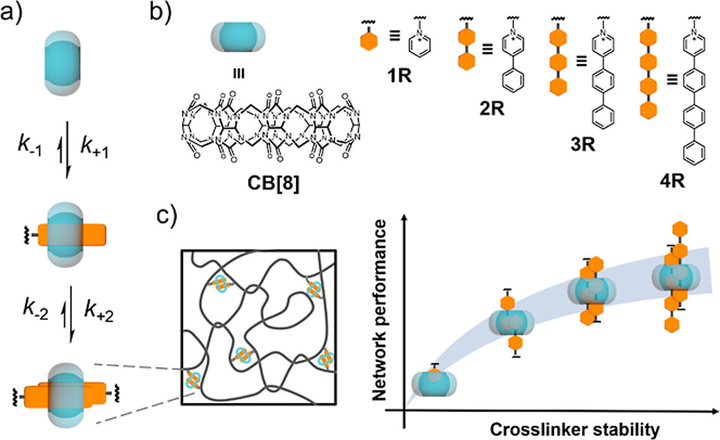 Image credit: Source
摘要
Supramolecular polymeric networks derive adaptability, processability, and toughness from reversible cross-links whose association and dissociation govern their macroscopic mechanics. Yet for many high-affinity linkers, their kinetic lability with high dissociation rate (kd > 1 s–1) restricts load bearing and network strength. Here we present a molecular-engineering strategy to kinetically stabilize supramolecular cross-links using a cucurbit[8]uril (CB[8]) host–guest platform. By extending the guest’s aromatic backbone to enhance intracavity π–π stacking and suppress axial slippage, we reduced the dissociation rate constant by over 100-fold to 10–2 s–1. When incorporated into polymeric networks, these persistent linkages produce strong yet adaptive hydrogels, whose viscoelastic relaxation directly reflects the molecular dissociation kinetics. Their high solubility further enables dense cross-linking, yielding tensile strengths up to 2 MPa and compressive strengths above 40 MPa. This work establishes molecular engineering of cross-link kinetics, demonstrated through the CB[8] model system, as a general and effective strategy for building high-performance supramolecular polymeric materials.